Showing posts with label Careers/Education. Show all posts

Wednesday, January 27, 2016

How educated is Bear River's workforce?
It depends on how you look at it — based on where they work or where they live.

Matt Schroeder, Regional Economist

Local leaders have become increasingly aware of the relationship between the education level of their local workforce and the economic strength of their communities. Higher levels of education are closely linked to higher incomes for individuals; which, in turn, brings in higher tax revenues and lower government social program costs. People with higher education levels tend to be healthier, more involved in community organizations and give more to charity. They are also less likely to be chronically unemployed, less likely to require social assistance, and have lower incarceration rates.

More broadly, when businesses look to expand or locate in a particular area, one of the primary factors they consider is the availability and training of the local workforce. A region with a more highly educated labor pool will tend to draw businesses that need highly educated employees. Those jobs, in turn, tend to garner higher wages. Higher wages mean more consumer spending and tax revenue for local governments, which allow for investment in infrastructure, public services and community development.

These benefits have long been known and I mention them to highlight why so much emphasis is often placed on education in the public arena. It really matters for community health and development. But there is an interesting question to this issue that is seldom explored when we think about how to better educate our local workforce: Should we focus on the education levels of the people who live in our communities, or on those who work in our communities?
To clarify, we’re talking about community investment in increasing higher education attainment levels, not the funding of primary and secondary education. On the resident workforce side, this may include expanding post-secondary degree programs and institutions, or encouraging and supporting student enrollment in higher education. On the working workforce side, higher levels of educational attainment are achieved by growing the number of jobs that require higher levels of education. Community investments to achieve this may include developing infrastructure and facilities to meet the needs of businesses, incentives for target industries.

For a local city or county considering investing in these types of development projects with limited funds, where should their focus be? This is an especially relevant question in an area like Bear River where the local commuting patterns are very fluid. Thousands of commuters flow along I-15 and Hwy 89 every day to jobs in other cities and counties. A well-educated engineer, for example, may be living in Brigham City, but commutes up to Logan every day for work. Should local leaders be concerned with developing a better-educated resident workforce if they are likely to just commute somewhere else for work? Or should the community be more focused on bringing in the kinds of jobs that will help keep an already well-educated population working closer to home?

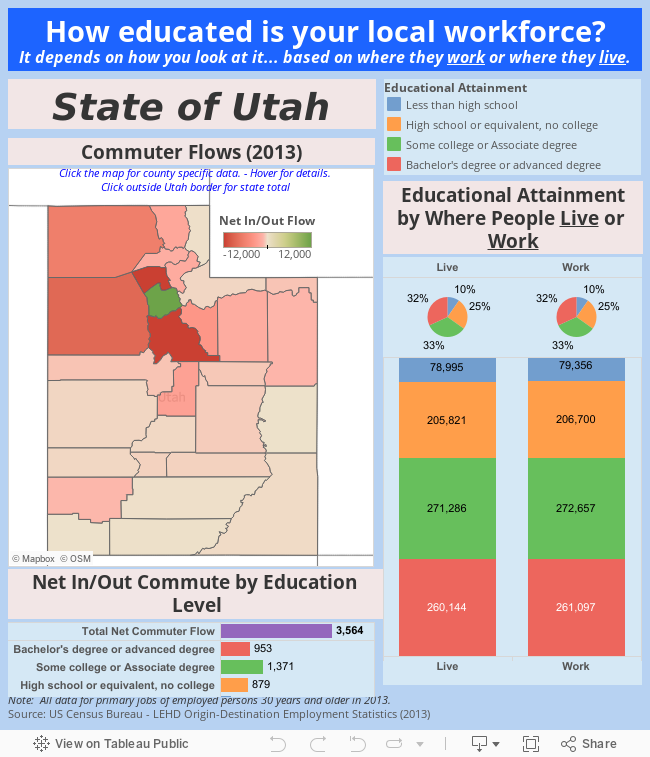
The answers to these questions depend on the specific characteristics of local economies, and unfortunately, no single answer or formula can be applied across the board. As a start, it helps to first have a picture of what’s actually happening. The interactive data visualization above allows you to see the situation for your county. Click on the map to see your county and hover over each chart to see details and an interpretation of the data.

In Box Elder, Cache and Rich counties more people commute out for work than come in. Of the three, Box Elder County has the largest net outflow, with more than 6,400 net out-commuters representing about 35 percent of the resident workforce. Of those 6,400, about 30 percent, or nearly 1,900 net out-commuters, have a bachelor’s degree or higher. The share of workers with a bachelor’s degree living in Box Elder County is 27 percent while the share working there is 26 percent. This is a relatively balanced out-flow in terms of educational attainment, but the fact remains that nearly 1,900 highly skilled workers are leaving every day for work. Ease of access to the rest of the Wasatch Front via I-15 and the short commute up to Logan make this possible, but many would likely stay closer to home if the jobs existed to support them.

Cache County has far fewer out-commuters in both percentage terms and in total numbers. The net out-flow of about 2,200 workers represents just 7 percent of the resident workforce and fewer than 600 of those leaving have a bachelor’s degree or higher. The result is that the share of workers with a bachelor’s degree or more working in Cache County is actually higher than the share of those living in Cache County — 31 percent vs 30 percent.

Rich County also has relatively little out-flow. More people commute out for work than come in, but the net outflow of 52 represents only 12 percent of the resident workforce. However, 33 of those 52 out-commuters have a bachelor’s degree or higher. The resulting share of people working in the county with that level of education is much lower, at 25 percent, than the share living in the county, at 29 percent.

Each of these counties is distinct in terms of the factors that play into why their worker flow patterns exist. For Box Elder and Rich Counties, there is clearly a current resident population more educated than the local job market demands. It may be worth exploring the possibility that those areas may benefit from a greater focus on high-skilled job creation. Cache County, on the other hand, is more balanced in terms of the share of highly educated workers that live and work there, so they may benefit most from a two-pronged approach that seeks to bring in higher skilled jobs while at the same time building the workforce to fill them.

Thursday, October 2, 2014

USU Breaks Ground on Electric Roadway Test Facility

Utah State University broke ground Sept. 23 for its Electric Vehicle and Roadway (EVR) Research Facility and Test Track, the first facility of its kind in the United States.

The complex will include a 4,800-square-foot research building and electrified quarter mile oval-shaped test track designed to demonstrate in-motion wireless power charging for electric vehicles. The EVR will be located near the existing USU Power Electronics Lab at USU’s Innovation Campus to leverage the combined capabilities of the two facilities.

The EVR will work toward developing electric vehicles with unlimited range. Using wireless inductive power transfer pads embedded in the roadway, electric vehicles can seamlessly charge while in motion, drastically reducing the need for large battery packs and cumbersome charging stations. Utah Business

Thursday, September 4, 2014

Long-Term Employment Projections

The long-term employment projections have been updated for the time period of 2012 to 2022. Projections are produced for the state of Utah as well as for eight sub-state areas. The areas are determined by population and job density and are not created equal. But rather, types of jobs are determined by the nature of the local area’s economy. Short-term projections for 2012 to 2014 are also provided for statewide.

The value in providing these projections is to help identify which types of jobs are most likely to be in high demand in the future. Ultimately, the long-term employment projections act as a forecasting measure by which individuals as well as organizations and agencies can plan ahead.

See the latest long-term projections produced by DWS for the Bear River area.

Friday, August 29, 2014

A Story of Wage Data

The Wages and Income page has a new look to the wage data that is gathered by the Workforce Research and Analysis division. Along with visualization of the data, you can now read story points at the top of each graph, to help understand what the data is showing you along with highlighting its insights. Just click along the story points at the top of the visualization to follow the story of wages.


Thursday, February 13, 2014

The Value of Education in Bear River

Tyson Smith, Economist


Although college tuition has increased at an meteoric pace over the last 50 years, the value of obtaining a college degree still outweighs the costs according to a new study from the Pew Research Center. In fact, the study argues that “On virtually every measure of economic well-being and career attainment—from personal earnings to job satisfaction to the share employed full time—young college graduates are outperforming their peers with less education.” Not only are young graduates economically better-off than their peers, but the disparity in financial well-being is greater for this generation than any other generation in modern history.

Click on Chart to Enlarge Image
You may be wondering, “What is the effect of educational attainment on people that work in my county?” While we don’t have access to the same data at the county-level that the Pew Research article uses, there are proxies that can illuminate the value of education in Bear River. The U.S. Census Bureau publishes the American Community Survey (ACS), which includes five-year population estimates for areas as small as census tracts and block groups. The ACS collects data on employment, education, and income. We can use ACS data to estimate the economic impact of higher education for each county in the state.

The Bear River counties follow the same pattern as national trends. College graduates earn significantly higher wages than high school graduates. Furthermore, the proportion of college graduates living in poverty is much lower than the percent of high school graduates or less.

The ever-increasing costs of pursuing higher education, and the perilous consequences of astronomical student debt, have been well documented. However, it appears that the benefits of graduating from college continue to outweigh the costs.


Note: For more analysis of the favorable influence of educational attainment in the State of Utah, click here.

Thursday, February 28, 2013

Logan School District wants bond to ease class overcrowding

Logan High School is seeing class sizes at levels it hasn’t seen in the past, with some classes having 50, even 60 students.

The problem: not enough teachers.

The Logan School Board is looking to put a bond and a levy on the ballot, but that money, if approved, wouldn’t be available until 2015.

Bill Emmett teaches Advanced Placement English at Logan High. He has more than 200 students and his largest classes seat more than 50 students.

"(The) problem becomes, of course, the more students you have in terms of total load, the more papers you have to correct, the more time you need to devote to the grading of papers,” Emmett said.
Having so many students in class means teachers may not have the time to give individual attention to every student.

Administrators say the problem started when the economy made a downturn a few years ago. “We did a reduction in staff two years ago when we were at the height of the financial crisis," Logan School District Superintendent Marshal Garrett said. But the school population didn’t change much, so each teacher has 180 students enrolled in their classes.

The Logan School District is hoping to fix overcrowding by asking taxpayers for $900,000 in a levy vote this November. Even then, however, the money wouldn't become available until the 2015 school year. It also plans to add a $40 million to $55 million bond to the November ballot, with about $35 million going toward updating Logan High School classrooms. Deseret News

Wednesday, February 6, 2013

Sod fills site in lieu of science building

On a campus filled with buildings, two trees spring up from an empty site just east of the University Inn. Unfortunately for students, the allotment of funds needed to construct a building here could be just as sparse as the site’s vegetation.

USU is asking legislature for $45 million in order to construct a new biological sciences building on the location, but according to some campus officials, the outlook does not look good.

“It didn’t score real high on the statewide priority list,” said Ben Barrett, director of Facilities Planning, Design and Construction. “It’d be a long shot this year for that project. This is the first year we’ve submitted for that project. Quite often that’s something you kind of have to get in line for.”
While $45 million would help the project, Jim MacMahon, dean of the College of Science, said it would take even more money to fund the building’s construction.

Barrett and MacMahon said it is possible USU will get partial funding for the project this year, which will allow them to begin design work. Barrett said the design work alone on a building of this size would take almost a year to complete.

Knowing it was not likely the project would be approved its first year of submission, Barrett said they laid sod and installed an irrigation system in order to make the land available for campus activities, as well as to provide an environmental benefit and save time spraying weeds. USU Statesman

Tuesday, February 5, 2013

USU receives grant for online learning

Utah State University has been awarded a research grant from the Division of Undergraduate Education at the National Science Foundation.

The grant is for a project aimed at improving retention of engineering undergraduate students within the critical first two years of study. The three-year grant begins this month.

The grant enables USU to implement and formally evaluate the use of online learning forums within distance delivered sections of the engineering calculus course sequence, taught within the USU distance education system. The goal is to help graduate more professionals into engineering and other science, technology, engineering and mathematics — STEM — disciplines. Deseret News

Thursday, January 31, 2013

Aggies ask legislature for building funds

Students lobbying for USU during the Utah state legislative session this year plan to try a more positive approach than in previous years with the politicians who decide how much money higher education receive and what projects do and do not get a stamp of approval.

USU will ask the legislature this year for $60 million to build a new biological sciences building and renovate labs in the Biology and Natural Resources building, as well as seek approval to bond money to build a student recreation center, said Neil Abercrombie, director of government relations. The university also has plans for a $20 million instructional building at USU Eastern.

Public colleges and universities around the state, including USU, send student-staffed lobbyist groups like the GRC to the state capitol every year to lobby for funding and projects. These schools use events like the annual Research On Capitol Hill Day, where student research projects go on display in the state capitol rotunda to persuade legislators their projects are worth funding.

Wilson said the GRC’s approach to legislators will be more positive this year, explaining the great things USU does rather than why it needs more money. Utah Statesman

Thursday, December 13, 2012

Logan makes number 10 on The Cities Where Everyone Has a Job

While the U.S. unemployment rate has improved markedly from the double digits during the recession, it was still stuck at 7.9% as of October. Some regions fare far better than rest of the country, despite the fact that more than 12 million people are still considered unemployed in the U.S. 24/7 Wall St. looked at the 10 metropolitan areas in the U.S. where unemployment barely exists.

Higher education and industries that support it are the reason these metropolitan areas are doing well. College towns across America tend to have lower unemployment rates than the population as a whole, Martin Kohli, Chief Regional Economist for the Bureau of Labor Statistics, explained in an interview. Universities often provide relatively stable jobs compared to employment in cyclical industries such as construction. The University of Iowa is located in Iowa City, Iowa State University is located in Ames, and the University of Nebraska is located in Lincoln —all three metro areas are on our list.

24/7 Wall St. identified the ten metropolitan areas with the lowest unemployment rates as of October, based on data from the Bureau of Labor Statistics. State and local median household income was obtained from the U.S. Census Bureau. Data on the biggest industries was also obtained from the BLS.

10. Logan, Utah-Idaho
  • Oct. 2012 unemployment rate: 3.8% (tied for 9th)
  • Total population:124,813
  • Median household income: $46,356
While the October unemployment rate was less than half of the national rate of 7.9%, the metropolitan area is not affluent. In fact, the 2011 median household income in the area was much lower than the national median of $50,502 and the state median of $55,869. Only 2% of families in the Logan made more than $200,000 in 2011, significantly less than the 5.6% of families across the U.S. Utah State University, which employs more than 2,600 people, is located in Logan. Education and training represents just shy of 10% of the total workforce. 24/7 Wall Street

Friday, November 23, 2012

Expanding USU Supported by Board

Expanding the campus of Utah State University in Brigham City will be of great benefit, not only to students who attend, but to the city as well. Ron Frandsen, District business administrator, explained to the school board members the expectation of continuing the Interlocal Cooperative agreement with the Redevelopment Agency of Brigham City.

Five local entities are involved in the agreement, including the school district, Brigham City, Box Elder County, Mosquito Abatement and the Water Conservancy District. They provide financial support for development of the Old Indian School property for USU expansion through continuation of the tax increment program.

Also included in the agreement is the proposal to use the majority of taxes paid by any future development on the property to help provide matching funds to construct the building. Hopefully funds will be available through future legislature allotment.

Despite a district-wide policy stating otherwise, the Box Elder High School wrestling team will be taking a trip to Reno, Nevada, for a tournament there.

Policy 5323 concerning out-of-state travel limits high schools to two trips per year. Box Elder high principal Darrel Eddington has awarded those trips to the Drama Club and to the orchestra.

Coach Mike Ripplinger called this team the best he has ever had and this trip would bring an opportunity for them to wrestle in front of coaches from colleges and a possibility for wrestling scholarships. The Leader

Monday, October 22, 2012

Seventh-graders explore career options at Richmond middle school

For seventh-graders at White Pine Middle School, starting a career is probably the last thing on their minds.

But educators think it’s a good time for the kids to start thinking about what they want to do when they grow up. On Wednesday (of last week), the Richmond middle school conducted its annual Career Day, during which professionals from all over the valley came in to talk to the students about what they do for a living in hopes to get the students thinking about their futures.

“The purpose is to figure out some careers they may be interested in and maybe eliminate some that they wouldn’t be interested in,” said Tina Baggaley, a teacher in the Career Center at the school. “A lot of it is fun, and they’re going to learn a lot along the way.” Herald Journal

Friday, August 10, 2012

Box Elder County's first charter school hopes to complement, not compete

The nearly 450 students who will be the first to walk through the doors of the Promontory School of Expeditionary Learning this fall will experience a "cutting edge" education that started with parents discussing educational options and ended with the formation of Box Elder County's first charter school.

There is a growing body of evidence that supports the success of the expeditionary learning model. According to information from Expeditionary Learning, the organizing body of the educational model, several studies show that students who attend expeditionary learning schools outperform their peers in traditional school in English/language arts and math; have greater problem-solving, critical thinking and research skills; and are better prepared to be successful in college and the work place. Currently, about 165 schools in 30 states use the expeditionary educational model.


Under the charter school system, which the Utah State Legislature passed into law in 1998, the money from the weighted pupil unit (WPU) for each student goes to the school that student is attending. With the WPU at $2,842, Box Elder School District lost $1,122,590.

Box Elder School District Superintendent Ron Wolff said, in a case of good news/bad news, the district was able to reduce expenses to cover the loss, but it came as a result of staffing cuts forced by enrollment changes due to PSEL. Box Elder School District had to cut 11 positions due to decreased enrollment in traditional schools. Box Elder News Journal

Wednesday, July 18, 2012

$800k tax increase approved for Box Elder District

The board's regular meeting on Wednesday, July 11, Box Elder School District Business Administrator Ron Frandsen made a case to the board why the increase to the State of Utah's certified tax rate, which would increase the district's current tax rate by .000283, from 008442 to .008725 percent, was necessary.

What's ultimately to blame for the necessity of the increase is a stagnant economy and depressed property values that have led to decreased tax revenues from across the state, according to district Superintendent Ronald Wolff. The Utah State Tax Commission increased the basic school levy to compensate for the reduction in revenue and districts must abide by the increase if they want to participate in the state's equalization program, which reallocates money from more wealthy districts to needier ones.

It was also explained the district is dealing with a new property tax financing structure. This year, in an effort to simplify school district budgets, the State Legislature reduced the number of line items districts could specifically levy taxes for. As a result, some property tax revenue is accounted for in different funds than in the past. Box Elder News Journal

Thursday, June 21, 2012

Utah State University shuttle system getting wireless electric bus

If batteries did not weigh or cost so much, most drivers might be wheeling electric vehicles by now.

A new Utah State University technology could overcome this barrier to electrically powered transport. How? By transferring power through the air, from charging pads embedded in a road to a vehicle’s undercarriage 10 inches above, minimizing the need for on-board power storage.

This fall a USU start-up company will test the economic viability of such as wireless power transfer, or WPT, in the shuttle bus system at the University of Utah. Fueled with a federal grant, the U. is installing charging pads at bus stops and buying new electric buses to supplement its 28-bus fleet of diesel and compressed natural gaspowered vehicles. Salt Lake Tribune

Monday, June 11, 2012

Hitting a Milestone

At Utah State University, USTAR teams have reached new milestones by working together on genomic research projects resulting in two sets of transgenic twin goats. Double the research—double the fun.

USTAR at Utah State University was designed, in part, to foster collaboration between USTAR faculty and core university faculty to build on established university research areas of strength.

Two USTAR teams, represented by Randy Lewis, of the Synthetic BioManufacturing Institute, and Irina Polejaeva, of Veterinary Diagnostics and Infectious Diseases, worked together to design the goats using genomics technology. Both sets of twin were created with different proof of concept milestones in mind.


Lewis, a member of the Synthetic BioManufacturing Institute at USU, uses transgenic goats to produce milk with spider silk proteins. The proteins are purified and spun into fibers that can be used to create technical fabrics as well as artificial ligaments and tendons. Stronger than Kevlar and more flexible than nylon, Lewis’s spider silk has been used to craft a bullet resistant skin and can be used to create a next generation solution for parachute cords.

Lewis selected his best spider silk milk producer, Daisy, gave her skin cells to the VDID team and ask them to create the first set of cloned spider goat twins born at Utah State University. “Because we need large quantities of milk to get large quantities of silk, it makes sense to copy our best producer,” said Lewis." Utah Pulse

Tuesday, April 3, 2012

Despite budget crunch, university has been able to build on

Today, buildings with grandiose architectural designs and state-of-the-art scientific features now seem to technologically overshadow Old Main — like the green solar panels bolstered on the side of the new Agricultural Sciences building or the towering brick structure of the Emma Eccles Jones College of Education and Human Services. Not too far away is the USU Innovation Campus, which houses ultra-modern buildings dedicated to research efforts.

Since 2008, when the nation’s economy fell into a recession, the eight public colleges and universities within the Utah System of Higher Education lost ten of millions of dollars in state appropriations — $25.2 million of which was cut from USU alone. But even over those last four years, those institutions, including USU, have built and will continue to build more facilities.


 Elsewhere in the state, Utah Valley University broke ground last year for a $30.6 million, 160,000-square-foot science building and the first phase of the University of Utah’s new home for its School of Business was completed last year, rising eight stories over the south end of campus.

The situation seems to be at odds with USU increasing tuition, laying off employees and experiencing a significant shortfall in operation and maintenance funding from the state — all due to the budget cuts. The answer to how USU is able to build as many buildings as it has is a not an easy one, but it is commonly misunderstood where building funding comes from.

Dave Cowley, USU’s vice president for business and finance says the same pot of money used to fund buildings is not the same pot used for faculty and staff compensation increases. Some of those dollars are one-time funds — to actually build a facility — while others are on-going from year to year — in order to keep the facility running year after year. Herald Journal

Friday, March 30, 2012

USU students create solutions for Bear Lake area's design problems


More than 50 posters covered an entire wall inside the Garden City Office Building on Wednesday night ready for government officials to view possible solutions to local problems.

Complete with text, full-color artistic renderings and charts, each poster showed ideas of how to solve some of the Bear Lake region’s most urgent design problems.

A group of students from Utah State University’s landscape architecture and environmental planning, or LAEP, department shared these solutions with the Bear Lake Regional Commission, a group of city and county officials created several years ago tasked with finding solutions to the Bear Lake Valley’s future growth and development.

The team has worked with the commission since the beginning of the school year on designs for several cities in the region, including Garden City, St. Charles, Laketown, Paris, Bloomington, Pickleville, Fish Haven and Montpelier. Daily Herald

Monday, November 7, 2011

USU vet med program a reality

After years of planning and a big push by Utah State University officials during this year's legislative session, the joint doctorate of veterinary medicine program is finally lifting off the ground. The USU Board of Trustees approved some administrative restructuring Friday that will create a School of Veterinary Medicine, the first professional program in veterinary medicine offered in Utah. The approval means the school will be established in January 2012. At that time, a review of applications to admit the first group of students will commence, Noel Cockett, the dean of the College of Agriculture, told Trustees. Herald Journal

Monday, May 23, 2011

Planned layoffs in Logan School District

The Logan Board of Education’s decided to reduce personnel in light of recent budget cuts. After multiple joint meetings with classified, licensed and administrative employees’ associations, a decision was made to reduce the number of employees in the district. Approximately nine licensed employees at Mount Logan Middle School, 8.5 at Logan High School and a half-time position at the elementary level will face layoffs. At least four applications have been submitted for retirement, which will be included in the positions to be cut. Logan Herald Journal