Showing posts with label Agriculture. Show all posts

Wednesday, November 4, 2015

Agricultural Employment – The Census of Agriculture Gives a More Complete Picture

By Matt Schroeder, Regional Economist

Farming, (or more generally, agriculture) is obviously an important part of the economy, so why is that when you hear employment statistics reported in the news, you typically hear them reported as “nonfarm” employment?

“Nonfarm payroll employment” is terminology from the Bureau of Labor Statistics’ Quarterly Census of Employment and Wages (QCEW), and the term is slightly misleading. There is, in fact, some data on agricultural employment in the QCEW data typically reported, it’s just not complete. QCEW employment data is based on administrative records from employers who pay into the state’s Unemployment Insurance (UI) program, so workers not covered under UI laws are not captured. Agricultural employers are generally exempt from the requirements for UI coverage, so the data are simply not comprehensive enough to calculate reliable estimates. Furthermore, many agricultural operations are sole-proprietorships that are also exempt from UI coverage (whether in agriculture or not), so those individuals are not recorded either.

All of this comes down to the fact that the typical “nonfarm” employment statistics you hear about in the news, on average, do not include roughly 90 percent of Utah’s agricultural employment. In 2012, QCEW reported fewer than 5,000 employees in “Covered Agriculture,” for the whole state, which represented less than one half of one percent of Utah’s total employment.

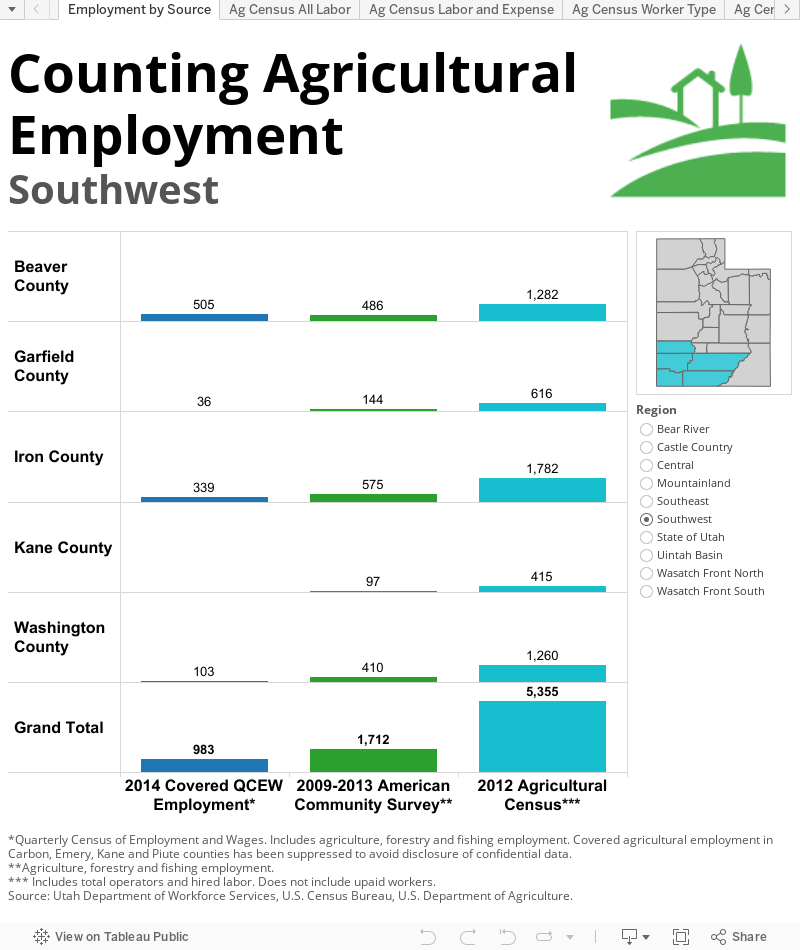
Fortunately, the Census of Agriculture, conducted by the U.S. Department of Agriculture once every five years, gives a revealing picture of the agricultural sector. The most recent data, covering 2012, were released last May 2015. The Agricultural Census surveys all of those UI-exempt farms that the QCEW misses and found that there were nearly 47,000 jobs in agriculture in 2012 — more than 3.5 percent of Utah’s total employment.

In the Bear River region, agriculture is an even larger share of the local economy — nearly 10 percent according to the Census of Agriculture. Box Elder and Cache counties respectively rank 2nd and 3rd in the state in terms of total agricultural employment. Rich County is relatively small in total number, but the share of jobs in agriculture is more than 45 percent.

Agricultural Profile of Bear River


By Matt Schroeder, Regional Economist

The visualization above uses data from the 2012 Census of Agriculture to profile the agricultural activity of the Bear River region. You can adjust the filter to view individual counties or groups of counties as well as change the year to 2007 to see how things have changed since the last Census of Agriculture. To view the profile of the whole state, select “Statewide” alone.

As a whole, Bear River had more than 2,600 farms in 2012 representing more than 14 percent of the state’s farms and about 17 percent of the state’s farm acreage. The bar chart in the center suggests that of those farms, more than 1,800, or about 70 percent, were small to mid-sized farms with less than 180 acres.

The title above the map at the right shows that roughly 36 percent, or 1.85 million acres, of Bear River’s 5 million acres of land are used for agriculture. The pie chart at the bottom-left displays that about 1.24 million acres of that are pasture and rangeland while only about half a million are cropland, highlighting the importance of livestock in the region.

In terms of value, Bear River’s agricultural sales composed more than 19 percent of the statewide total. The second pie chart, at the bottom-right shows that of the $345 million in agricultural sales in 2012 more than 65 percent was from the sale of livestock and related products. Nearly $100 million in cattle sales and $100 million in milk sales composed the largest proportion of that. Of the crops sold, the largest category, in terms of value, was hay, again highlighting the importance of livestock in the region.

Tuesday, January 8, 2013

Brigham City OKs Controversial Hotel for Downtown

The city council approved a development agreement with Western States Lodging to bring a Hampton Inn, part of the Hilton chain, to downtown. The nearly $6 million hotel will be connected to the proposed Academy Square.

David Webster, CEO of Western States Lodging and a resident of Mantua, said the management company is aiming for construction to begin in late spring, with the hotel set to open before year’s end. Under that agreement, it will purchase the ground surrounding the Academy Square building for $500,000.

As part of the financing, the city will host a loan for $400,000 from the U.S. Department of Agriculture that is designed to encourage development in rural areas.

Concerns about the city’s financial dealings in bringing the hotel to the city, as well as the issue of fairness to existing Brigham City hotels, has prompted continued public comment about the project at city council meetings over the last few months.


Paul Larsen, Brigham City’s director of community and economic development, said the architecture of the Hampton Inn will be designed to match the flavor of Academy Square.

At the center of the Academy Square project is the Academy Building, also known as the Christensen Academy of Music and Dance, which was built in 1903 as a dance and arts academy by the Christensen brothers. One brother, Bill Christensen, went on to found Ballet West.

The restoration of the old academy is projected to cost about $2 million.

Councilwoman Ruth Jensen reminded the council that the Academy Square project was to be paid for through private fundraising, but the city’s involvement, she said, has been expensive in areas such as land purchases and time spent by city employees facilitating the development.

As part of the development agreement, Western States Lodging will oversee daily management of the Academy Square. It will serve as a convention and reception facility that, Webster said, will be available for wedding receptions and high school events. Standard Examiner

Thursday, November 29, 2012

Brigham City Seeks Input on Economic Strategies

The Brigham City Community and Economic Development Department – with support from Box Elder County – has been conducting a study in order to develop strategies that will help to grow four distinct business clusters in the community that are comprised of the aerospace and composites, structural steel, shooting sports and agricultural areas of concentration.

Box Elder County’s economic development director, Mitch Zundel, said that while this is primarily a Brigham City driven project, the county is following along closely since the scope of the cluster analysis will impact the county as a whole.

Through grants from the U.S. Department of Commerce and other federal, state and local agencies and businesses, Brigham City Corporation has hired former Ogden City Mayor Matthew Godfrey’s consulting firm to draft this industry cluster analysis. Box Elder News Journal

Thursday, August 2, 2012

Box Elder County says grasshoppers eating crops

The U.S. Department of Agriculture says grasshoppers are causing some crop damage in Utah's Box Elder County.

The grasshoppers are moving from dry areas to munch on hay and other green crops grown by irrigation.

Elsewhere, agriculture officials say monsoon rains sweeping across parts of Utah are improving crop conditions.

Cache County, however, continues to see hot and dry conditions. Standard Examiner

Monday, June 11, 2012

Hitting a Milestone

At Utah State University, USTAR teams have reached new milestones by working together on genomic research projects resulting in two sets of transgenic twin goats. Double the research—double the fun.

USTAR at Utah State University was designed, in part, to foster collaboration between USTAR faculty and core university faculty to build on established university research areas of strength.

Two USTAR teams, represented by Randy Lewis, of the Synthetic BioManufacturing Institute, and Irina Polejaeva, of Veterinary Diagnostics and Infectious Diseases, worked together to design the goats using genomics technology. Both sets of twin were created with different proof of concept milestones in mind.


Lewis, a member of the Synthetic BioManufacturing Institute at USU, uses transgenic goats to produce milk with spider silk proteins. The proteins are purified and spun into fibers that can be used to create technical fabrics as well as artificial ligaments and tendons. Stronger than Kevlar and more flexible than nylon, Lewis’s spider silk has been used to craft a bullet resistant skin and can be used to create a next generation solution for parachute cords.

Lewis selected his best spider silk milk producer, Daisy, gave her skin cells to the VDID team and ask them to create the first set of cloned spider goat twins born at Utah State University. “Because we need large quantities of milk to get large quantities of silk, it makes sense to copy our best producer,” said Lewis." Utah Pulse